Visit to the Record Office

Guide: Jess Jenkins

20 June 2017

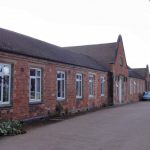
For the June meeting, members visited the Record Office in Wigston, where our guide was archivist Jess Jenkins.

The Record Office is a service provided by Leicestershire County Council in partnership with Leicester City Council and Rutland County Council. Its purpose is to collect and make available a wide range of resources for researching the history and culture of Leicestershire, Leicester and Rutland. The collection dates back to the 1100’s and continues to grow. The Record Office moved from New Walk to its present site in Wigston in 1992. It amalgamated with the local studies library so that everything relating to the history of Leicester, Leicestershire and Rutland was housed under one roof.

Jess provided a variety of documents and books for us to look at. The oldest document we saw was a transfer of title of land in Saddington dating from around 1230 AD, written in Latin on parchment and with a large wax seal attached. A number related to Thurcaston and Cropston including records from the Archdeaconry of Leicester of 1517, showing the will of Everard Falkener of Thurcaston. Another was a 17th century accounts book which held the church accounts at the front and those of the village constable at the back, as both offices were held by the same man.

Other notable items included: a record of a lion brought into Loughborough that killed a man; 1813 Marriage Records from Ashby-de-la-Zouch showing the marriages of a number of French prisoners of war to local girls; Burial Records of 1609 documenting plague burials; a page from the Admission Records for the Leicester Poor Law Union dated 29th December, 1879 noting the admission of Joseph Merrick (later known as the Elephant Man); and 1916 details of the Zeppelin raids when bombs were dropped on Loughborough killing 10 and injuring at least 12 people.

We finished with a tour of the Record Office, being shown: the microfiche readers and computer terminals which members of the public can use for their own research; the strong-room, with over 10km of shelving, in which the documents are stored in a controlled environment (pleasantly cool on a hot evening!); and the map room where we were given the opportunity to look at some local maps which concluded a most interesting evening.

For more details of the collection and services provided, visit their website: www.leics.gov.uk/recordoffice

Church Bells

Speakers: Brenda Hooper and Peter Hunt

16 May 2017

The May meeting was a talk about, and a demonstration of, church bells. Brenda Hooper (Hon President of the Society) told us the history of church bells, and Peter Hunt (Captain of Bellringers) described the bells in All Saints' church. At the beginning of the meeting we listened to the church bells ringing and the evening concluded with two tunes played on the hand-bells.

The sounds of bells have been heard through the ages in many aspects of our lives: calling us to prayer; warning of danger; waking us up; or telling us the time of day. The first account of a bell can be found in the Bible when Moses ordered bells to be placed on the hem of the High Priest’s robe[1]. Bells were first used in Christian churches around the 5th century and the Venerable Bede mentions a bell in Whitby for waking and calling the nuns to prayer[2]. The first mention of a bell in Thurcaston appears in the will of John de Mershden in 1425. He wrote, “if the parishioners of Thurcaston wish to make a large bell out of the medium-sized one they shall have £6.”[3]

Peter Hunt talked more about the bells in All Saints' Church, of which there are eight. The oldest and largest is the tenor bell, number 8, which weighs about the same as a small car. This is a very special bell known as a “Royal Heads Bell” decorated with the heads of King Edward III and Queen Philippa. The next largest, number 7, dates from 1614. Bells 3,4,5 and 6 were cast at Taylors Bell foundry in Loughborough in 1898, numbers 1 and 2 by Alfred Bowell of Ipswich in 1919. Peter went on to explain a little about ringing changes: a system using permutations which mean the bells never sound twice in the same order. If there are six bells this means 720 changes without repetition, if there are eight this increases to 40,320. One such has been rung at the Loughborough bell foundry and took 18 1/2 hours. A “peal’ consists of at least 5,000 changes lasting about 3 hours, a quarter peal is rung on special occasions taking approximately 45 minutes.

Brenda told us a little of the history of bell ringing: by the early 1800’s some belfries had become places for smoking, drinking and other unsociable activities. Thurnby Church saw disagreements between the vicar and the ringers when the vicar tried to stop them ringing the bells to signal the start of the hunt meeting. This dispute went to the Ecclesiastical court where the Judge concluded that the vicar’s permission must be obtained before church bells could be rung[4]. This law still stands.

Finally we heard a little about the hand-bells. Twelve bells were purchased in 2008 and a further thirteen in 2015, providing for changes of key and enabling a larger repertoire. We heard two tunes played: Bach’s “Sheep May Safely Graze” and “The Happy Wanderer”.

The hand-bell ringers rehearse in the Harrison Room on Thursday mornings and welcome new members.

[1] Exodus 28 v 31-35

[2] The Ven. Bede, Historia Ecclesiastica Gentis Anglorum. Ed A. Holder, 1895, Bk 4 Chap 23, p 207

[3] S.L. Ollard. Fasti Wyndesoriensis. The Deans and Canons of Windsor. Windsor 1950

[4] Rev. W.H. Pinnorck LLD. Cambridge. Church Key, Belfry Key & Organ Key. J.Hall & Son, 1870.

From Swithland Rectory to Vimy Ridge: The story of nature artist Otto Murray Dixon

Speaker: Anne Horton

21 March 2017

Herself a former Rector of Swithland, Anne became interested in the artist Otto Murray Dixon and her talk was punctuated with personal reminiscences and photographs from the family, and his pictures throughout. 

Henry Edward Otto Murray Dixon (known as Harry as a child) was born in 1885 a year after his father, James, became rector of Swithland. His earliest years were spent at the old 18th century rectory before the new one was built in 1891. His mother, Etheldreda, came from a wealthy family, the Trevelyan’s from Nettlecombe Court in Somerset, her grandfather a baronet and her father a rector. On his father’s side, Harry’s great grandfather was the landlord of the Red Lion in Henley upon Thames, a public house that George III is known to have visited.

Along with his two sisters Harry started school at Swithland in 1894. His earliest known picture is of a heron, labelled “for dear John” which was painted in 1897 when he was 12.   On it, he signed his name as Otto Murray Dixon.  He used one of the top rooms in the rectory as a studio.  From 1903 to 1908 he wrote Nature Notes about the birds he’d shot, the eggs he'd taken and the wildlife he’d encountered around Swithland.

His artistic education included Leicester School of Art, Calderon's School of Animal Painting in Baker Street, London and the Royal Academy Schools. He was also taught by Archibald Thorburn the noted wildlife artist.  JG Millais’s book British Diving Ducks published in 1913 contains his works, and many were published in the London Sporting and Dramatic Magazine and The Field.

Murray Dixon volunteered with the Seaforth Highlanders in World War I. He was commissioned in 1915.   In his memoir ‘Last Man Standing’  Norman Collins remembers him as a charming man, but that he was unable to remember to lead off on the left foot on parade. He painted throughout the war and included sketches in his letters home, focusing on the wildlife rather than the horrors of war.  His last known picture was ‘Rats in the Trenches’ (1917).  

He was fatally injured at Vimy Ridge on Easter Monday 1917 at the age of 31.  The first day of the Battle of Arras which was fought from 9 April-16 May and cost 165,000 British lives.   He is buried in Aubigney Communal Cemetery Extension . His father wrote “by someone, somewhere in France, a man of peace he fell in war, giving his life for others.”  He is remembered on Swithland War Memorial along with other young men who died in World War I.

The Vikings in and around Leicestershire

Speaker: Peter Liddle

21 February 2017

February’s meeting of the Thurcaston and Cropston Local History Society heard Peter Liddle (former County Archaeologist) talk about The Vikings - in and around Leicestershire. 

Peter started by setting the scene in Britain before the arrival of the Vikings, when England, as we know it now, was divided into Anglo Saxon Kingdoms. Leicestershire was part of Mercia, and other kingdoms included Wessex, East Anglia and Northumbria.  At that time Leicester was one of the important cities of the Mercian kingdom.  Unfortunately very little documentation from the period remains as it all disappeared with the Vikings. 

The first notable Viking raid was on Lindisfarne in Northumbria in 793 AD where the great Abbey was destroyed, the monks killed and its treasures looted and taken back to the Vikings’ homelands. For the next 60-70 years they made frequent coastal raids taking back treasure, goods and people - either as hostages or slaves.  In 865 AD the “great army” landed, this time not just to raid and loot, but to conquer the Anglo Saxon kingdoms.  In the next ten years the whole structure of Mercia changed as the Viking army rampaged through the country, taking lands and pillaging the countryside .

Although there is no written documentation of the Vikings takeover of Mercia, artefacts are sometimes found which give an idea of their life.  We know that they played board games such as Nine Mens Morris and Hnefatafl as playing pieces have been found.  Metal detectorists have been instrumental in adding to the knowledge of the times by discovering items such as broaches, horse fittings and coins.  One such, the Thurcaston Hoard, is a total of 12 Viking, Saxon and Arabic coins found in the parish by Brian Kimberley, this is now in the Fitzwilliam Museum in Cambridge .

The East Midlands formed part of the Danelaw, as place names with the ending ‘by’ show.  Many are nearby such as Frisby, Brooksby and Rearsby.   Leicester was one of the “Five Boroughs” of the Danelaw together with Nottingham, Derby, Lincoln and Stamford (the main towns of Danish Mercia).  Danish rule of the Five Boroughs was lost following the English reconquests under Aethelflaed (King Alfred’s daughter) during 916 and 917.  The area was then ruled by Earls of Mercia, until it was briefly reoccupied by the Danes in 941, but it was soon recovered by King Edmund in 942.

What business is it of yours?

Speaker: Sandra Moore

17 January 2017

For the first meeting of 2017 Sandra Moore made a return to the Society to tell us about some more of the characters buried in Belgrave Cemetery, this time in the character of Mrs Eliza Billington, landlady of the Bull’s Head, Belgrave (deceased).

Elisa lived from 1848-1915, a time of great change, with the coming of the railways, and the industrial revolution leading to the demise of the framework knitting as a cottage industry as large factories opened up around Leicester resulting in high unemployment.

Dressed in a costume of the period, she began her reminiscences with the men returning from the 1905 march to London. More than 400 men had walked to the capital and back, hoping to petition the King, to protest against the lack of employment opportunities in the area. (More details from the Leicester Mercury).

She talked a little about life as a publican at the Bulls Head, which she ran with her husband Thomas during the 1890s and into early 20th century. They started serving food while she was the landlady attracting a better class of clientele!

Using examples of people buried in the cemetery she described of some of the businesses and lives of people who she would have come into contact with in the Belgrave area of Leicester. These were illustrated with b/w photographs and postcards. They included Henry Wilkinson (1849-1904) who became keeper of the Victoria Model Lodging House in Britannia Street; Benjamin and David Exton who were bakers; Henry Pugh, the butcher; Thomas Hoskins, of Hoskins Brewers; and George Tebbs,  who started as an ironmongers assistant, and later owned an Ironmongery business, but was also a musician and a founder of the De Montfort Orchestra (profile of George Tebbs).

More well known perhaps was Walter Bentley born in 1866, who starting rose growing at Red Hill in 1890 and moved up to Wanlip in 1937 but the 2nd World War meant more land was needed for food and more than a million rose trees were burned. The most recent burial was that of Wilfred Barry Deacon in 2012. Better known as impresario Barry Young he bought Goscote Hall Hotel which he turned into a cabaret venue and later ran the Starlight Club in Coalville (tributes).

Sandra Moore assembled these stories by advertising in the local press for information from families of people who are buried in the Cemetery, and has therefore, received personal memories and family photographs with which to illustrate her talk.

For more details of Belgrave Cemetery visit the Friends of Belgrave Cemetery website.

Directions

Our indoor meetings are held at

The Memorial Hall
Anstey Lane
Thurcaston
LE7 7JA

If approaching from Leicester Road, the hall is on the left, midway between Leicester Road and Rectory Lane.

Parking is available at the roadside, please be considerate to local residents.

Current Programme

Visitors are welcome to join us - we ask for a donation of £4 per meeting.

Our summer meetings (June-August) are outings to local places of interest.   Please contact us if you would like to come along.

All other meetings start at 7:30pm and are held in the Memorial Hall, Anstey Lane, Thurcaston  LE7 7JA.   Please feel free to turn up on the day.

2026 Meetings

20 Jan 2026100 Years of Cycling
Stuart Warburton
17 Feb 2026The Diet of the Grey family at Bradgate
Rachel Small
17 Mar 2026History of Board Games
Peter Liddle
(Change of Programme)
19 May 2026Small Things Forgotten
Claire Strachan
16 Jun 2026Siege of Leicester Walk
Jim Butler
21 Jul 2026Visit to Shepshed Watermill
18 Aug 2026Tour of Whitwick
15 Sep 2026tbc
20 Oct 2026Remembering the Kegworth air crash
Alan Parker
17 Nov 2026Brief AGM followed by
Magical Mystery Tour
Bishop Peter Fox

15 March 2016

The Barrow Union Workhouse, speaker: Terry Sheppard

19 January 2016

The Cropston and Thurcaston Enclosures

Speaker: Peter Smith

Publications

Please contact us if you would like to buy any of the booklets below.  There will be a postage and packing charge, calculated for each order.

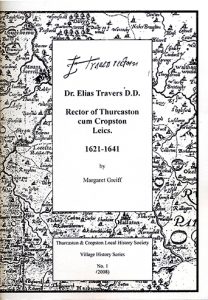
Dr Elias Travers DD, Rector of Thurcaston cum Cropston 1621-1641

by Margaret Greiff

The story of the first rector of the parish to be presented by Emmanuel College, Cambridge. At the time, the living of Thurcaston (which included Anstey and Cropston) was one of the richest in the county.

24 pages.

Price: £2.50 + postage & packing.

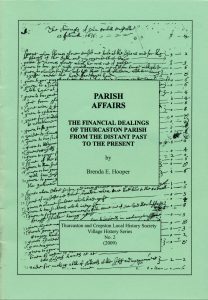
Parish Affairs: The financial dealings of Thurcaston Parish from the distant past to the present

by Brenda Hooper

How the Parish has provided local services by the collection of rates through the years. The booklet includes illustrations and reproductions of many original documents.

24 pages

Price: £2.50 + postage & packing.

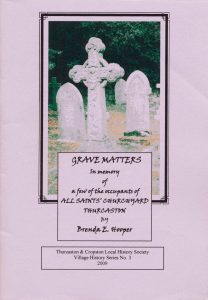
Grave Matters: In memory of a few of the occupants of All Saints' Churchyard, Thurcaston

by Brenda Hooper

The book details the history of gravestones and masons and touches upon the wills, inventories, inquest and burial certificates of some of the residents of All Saints' graveyard.

28 pages.

Price: £2.50 + postage & packing.


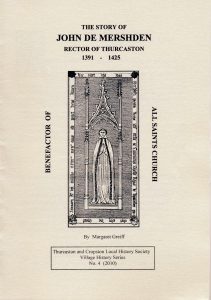
The Story of John de Mershden, Rector of Thurcaston 1391-1425

by Margaret Greiff

This booklet relates the fascinating details so far discovered about the man whose body lies beneath the memorial brass in the chancel of All Saints Church, Thurcaston.

20 pages.

Price: £2.50 + postage & packing.

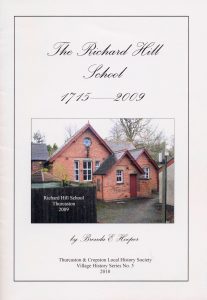
The Richard Hill School, 1715-2009

by Brenda Hooper

Describing the founding of the Richard Hill School in Thurcaston, this booklet uses documented evidence to follow its history from 1715 to the old building's final closure in 2009.

20 pages.

Price: £2.50 + postage & packing.


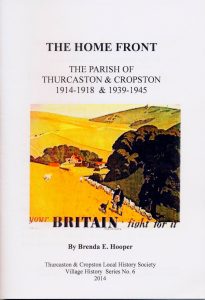
The Home Front: The Parish of Thurcaston and Cropston 1914-18 and 1939-45

by Brenda Hooper

How the men, women and children of our parish "did their bit" at home. Records from the Parish Council, primary school, WI and Memorial Hall Users Committee interwoven with some events and posters from the world wars.

38 pages.

Price: £3.50 + postage & packing.

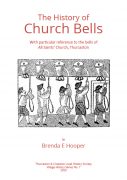
The History of Church Bells: with particular reference to the bells of All Saints', Thurcaston

by Brenda Hooper

An informative, readable history of church bells including details of Thurcaston's bells and amusing anecdotes.

34 pages, with colour illustrations

Price: £3.00 + postage & packing.